Why Every Brand Needs an AI Policy
Even If You’re Not “In Tech”
If your company doesn’t have an AI policy yet, here’s the uncomfortable truth: Your employees are already using it.
Many midsize business leaders we speak to have yet to enact AI policies as they assume they’re not applicable to their industry or only necessary for large enterprises. But many leaders fail to realize just how many ways AI is already woven into everyday work, mostly because they don’t directly see it (and workers aren’t always admitting to using it). Teams use chatbots to write emails, tools like Canva or Adobe Firefly to generate images, CRM features to summarize customer interactions and other marketing tech stack tools that are rolling out AI features by the day.
Without guidance and training, these AI tools can pose real risks to brands, including data leaks, brand inconsistency, compliance issues and reputational damage.
An AI policy sets guardrails so employees use AI in ways that are safe, responsible and aligned with your business goals. Even if your team only uses basic tools, you could still face challenges like:
Create space for questions and encourage experimentation (within the guardrails, of course).
The AI revolution is moving fast. Your policy doesn’t have to be perfect; it just needs to exist to help guide your brand.
Because whether you’re “in tech” or not, AI is already inside your workflows. The brands that thrive won’t be the ones that avoid it—they’ll be the ones that guide it intentionally.
Explore more insights, frameworks and practical tools in our AI Hub, or reach out to our team and we can tailor AI solutions that align with your business goals, compliance requirements and growth strategy.

Many midsize business leaders we speak to have yet to enact AI policies as they assume they’re not applicable to their industry or only necessary for large enterprises. But many leaders fail to realize just how many ways AI is already woven into everyday work, mostly because they don’t directly see it (and workers aren’t always admitting to using it). Teams use chatbots to write emails, tools like Canva or Adobe Firefly to generate images, CRM features to summarize customer interactions and other marketing tech stack tools that are rolling out AI features by the day.
Without guidance and training, these AI tools can pose real risks to brands, including data leaks, brand inconsistency, compliance issues and reputational damage.
Why AI Policies Matter
An AI policy sets guardrails so employees use AI in ways that are safe, responsible and aligned with your business goals. Even if your team only uses basic tools, you could still face challenges like:
- Accidental sharing of confidential information in public AI tools
- Inaccurate or fabricated AI outputs being shared with customers
- Copyright or licensing issues with AI-generated images or text
- Inconsistent quality and brand voice across teams
How to Build Your AI Policy
The goal isn’t perfection but rather getting started. Start with practical, easy-to-follow guidelines. Here are some foundational areas to address in your AI policy:- Approved Tools
- Which AI tools can employees use?
- Are there any tools that are off-limits?
- How does personal use of tools on corporate devices factor into your policy?
- Data Rules
- What information may never be entered into AI tools?
- A good place to start is to avoid sharing financial information and personal identifiable information (PII).
- What legal restrictions exist within customer contracts?
- This is a great place to pull legal and IT in.
- What information may never be entered into AI tools?
- Brand & Quality Standards
- How should AI-generated content be reviewed before publication?
- Are AI-generated images acceptable to use, especially for external sales and marketing purposes?
- Who owns final accountability for accuracy?
- Ethical Expectations
- What values guide your use of AI?
- How does AI align with your brand’s principles?
- Human Oversight
- When is human approval mandatory?
- Are there regulatory or compliance requirements in your industry?
- What level of transparency is required when AI is used externally?
Making An AI Policy Stick
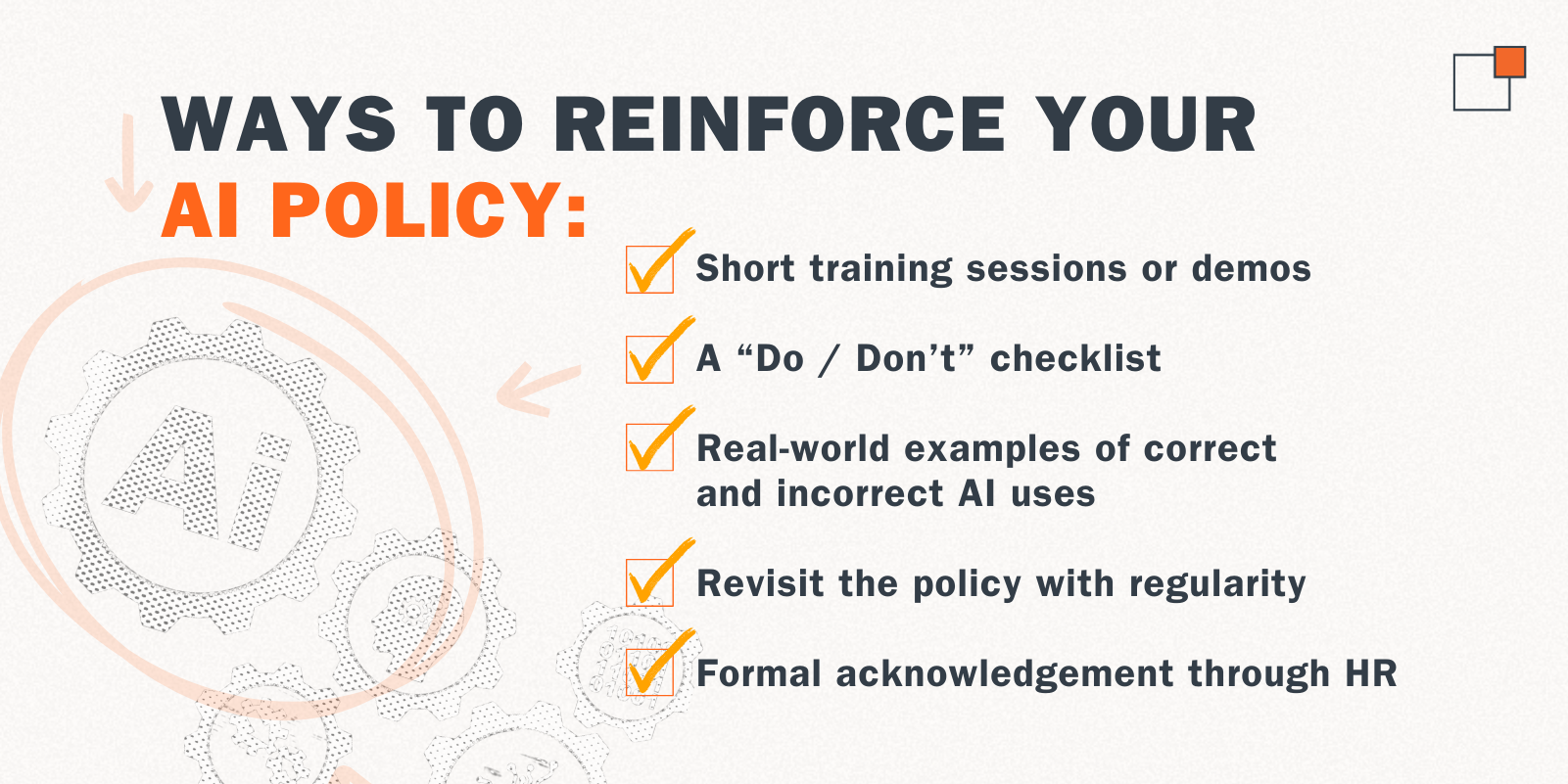
Creating a policy document won’t change behavior—it's just step one. Employees must understand it, remember the rules and feel comfortable asking questions. If you want adoption, consider reinforcing your policy with:- Short training sessions or demos—there are plenty available online
- A simple “Do / Don’t” checklist—the TL;DR version
- Real-world examples of correct and incorrect AI use—have some fun, but clearly show the risks
- Revisit the policy with regularity—put someone in charge and set a timeline
- Formal acknowledgement through HR—if appropriate
Create space for questions and encourage experimentation (within the guardrails, of course).
Start Now. Refine Later.
The AI revolution is moving fast. Your policy doesn’t have to be perfect; it just needs to exist to help guide your brand. Because whether you’re “in tech” or not, AI is already inside your workflows. The brands that thrive won’t be the ones that avoid it—they’ll be the ones that guide it intentionally.
Explore more insights, frameworks and practical tools in our AI Hub, or reach out to our team and we can tailor AI solutions that align with your business goals, compliance requirements and growth strategy.
About the Author
Jason Therrien is the President and CEO of thunder::tech. He is a fan of entrepreneurs and trailblazers, a proud dad and he liked scotch before Mad Men.