The Insider Report
A sit down with Kate Pixler
Sometimes marketing can feel like someone threw a drum set down the stairs: chaotic, loud and potentially alarming. This can be incredibly distracting because when you’re just hearing noise, it’s impossible to tell if something is working or just making a scene.
To find the cadence in that chaos, we sat down with Kate Pixler, Group Portfolio Manager at thunder::tech. Kate’s approach is about taking those scattered components and assembling them into a coordinated rhythm. For her, the antidote to marketing noise isn’t more volume, but a discipline of accountability that ensures every beat is deliberate.
It also changes how you view the customer journey. If the objective of a campaign is revenue, we aren’t just looking at impressions and clicks, we’re looking at the conversion quality. A campaign might bring in thousands of leads, but if they don’t convert to paying customers, the campaign didn’t actually succeed. Setting revenue-based goals early allows us to hold the creative and targeting accountable for the entire funnel, not just the top of it.
If that’s buying more than usual or signing up for a newsletter, success is found in those intentional touchpoints that prove our messages actually resonated. t::t:
You need your ‘blue chip’ long-term plays that build brand equity, but you also need high-yield, short-term tactics to hit your monthly revenue goals. Those short-term metrics matter, but only as part of a balanced strategy that moves you toward the bigger outcome. We can’t sacrifice future growth just to make this month’s report look good, but we also can’t ignore the immediate need for conversions. If a short-term tactic isn’t eventually feeding into the long-term revenue goal, it’s an expense you need to cut.
But you can’t feed those AI models without the right input, and that’s why community building has become a critical revenue outcome. In a world of AI-generated noise, real human conversation is the most valuable data there is. We’re looking at community engagement as a way to future-proof the brands we work with, because when your customers are talking to each other and advocating for you in public forums, it creates the authentic social proof that AI engines prioritize.
The real risk isn’t trying something new; it’s what I call the “Status Quo Tax.” When you stick only to what feels safe, your results eventually plateau while your costs go up. Testing isn’t about being flashy; it’s about finding the next lever to drive your costs down and your revenue up.
You don’t have to bet the whole farm. Carve out a small innovation budget—maybe 10%—to find what works next. It’s about doing the legwork now so that when you’re ready to scale, you’re doing it with a proven winner.
Because you’re paying such close attention to results, you can afford to try something bold. This approach turns what brands used to think are risks into calculated experiments. You’re doing the hard work of monitoring the pulse of your campaigns, so that when you see a spark of something new that works, you can pour gasoline on it. It’s not about slowing down; it’s about having the right dashboard so you can drive faster with confidence.
Don’t be afraid to try something different, but make sure it’s grounded in your results. For example, you might find that while your paid ads are driving traffic, it’s actually your organic social content and community discussions that are providing the social proof needed to close the sale. If your audience responds better to videos and testimonials over static images, you apply those learnings to your next project to make your spend go further.
When you treat every campaign as a learning opportunity, you stop guessing. You’re building a predictable engine that gets more efficient and more profitable every time you hit launch.
Kate only spilled a tad bit of our marketing knowledge—just imagine all the good stuff we packed into the latest edition of Marketing Trends. Download Read Between the Headlines: Rethinking Your Marketing Assumptions for free and give it a read!

To find the cadence in that chaos, we sat down with Kate Pixler, Group Portfolio Manager at thunder::tech. Kate’s approach is about taking those scattered components and assembling them into a coordinated rhythm. For her, the antidote to marketing noise isn’t more volume, but a discipline of accountability that ensures every beat is deliberate.
t::t: To kick things off, how important is it to define goals before launching a campaign?
Kate: At the end of the day, success needs to be defined by the goal, not the metric. And if you don’t have clear goals before you start, how do you know if you’re successful?It also changes how you view the customer journey. If the objective of a campaign is revenue, we aren’t just looking at impressions and clicks, we’re looking at the conversion quality. A campaign might bring in thousands of leads, but if they don’t convert to paying customers, the campaign didn’t actually succeed. Setting revenue-based goals early allows us to hold the creative and targeting accountable for the entire funnel, not just the top of it.
t::t: Following that logic, how should a brand actually define success once a campaign is live?
Kate: It’s different for every brand. Success has to come back to why you’re running the campaign in the first place. For example, we’re working with a service brand that had no digital footprint. Success there meant driving phone calls and appointments, not just impressions. For our retail and DTC clients, success can be a sales lift or a higher AOV (Average Order Value).If that’s buying more than usual or signing up for a newsletter, success is found in those intentional touchpoints that prove our messages actually resonated. t::t:
t::t: Even when that definition of success is clear, we often hear about a gap between hitting metrics and actually seeing revenue. Where do you see midsize brands struggle most when trying to bridge that disconnect?
Kate: It usually starts with not understanding their audience. You have to differentiate between your loyalists and your secondary audiences. If you treat a one-time shopper like a high-value loyalist, you’re overpaying for low-return customers and shrinking your margins. If you don’t know who those people are, you have to invest in research—talk to frontline employees, distributors and your actual customers. Without that foundation, you’re essentially paying a guessing tax, spending more on creative and tactics that may not even resonate.t::t: Once you have that foundation, how do you define accountability in marketing as it relates to the bottom line?
Kate: Accountability is about the hard work of continuous optimization. It’s the discipline to monitor the data daily and ensure the strategy is actually working. If it’s not, you have to be willing to pivot. I don’t believe in “set it and forget it.” True accountability means proving the ROI of every dollar and making sure the sales team has what they need to close the loop. When service delivers on that promise and earns a great review, it feeds right back into marketing. It’s a circle, and everyone is responsible for keeping it moving.t::t: Speaking of that circle, what happens to growth when marketing isn’t integrated?
Kate: Growth flattens when you have an attribution gap. If your social media team isn’t talking to your search team, you might see a spike in Google searches and think, “our SEO is winning,” without realizing it was actually a community discussion or a LinkedIn post that drove that person to search for you in the first place. When your marketing isn’t integrated, you’re looking at a broken puzzle. You might end up cutting ‘underperforming’ channels that were actually doing the heavy lifting of building trust. Integration is what gives you a clear picture of your entire buyer’s journey, so you can invest with confidence.t::t: With so many channels to manage, how can a brand balance short-term wins with long-term goals?
Kate: It comes down to having a roadmap. You need to know the end goal, then build checkpoints along the way. If a client is launching a new app, one of the short-term goals might be awareness, while the long-term goal is sustained usage and Customer Lifetime Value (CLV). I look at it like an investment portfolio.You need your ‘blue chip’ long-term plays that build brand equity, but you also need high-yield, short-term tactics to hit your monthly revenue goals. Those short-term metrics matter, but only as part of a balanced strategy that moves you toward the bigger outcome. We can’t sacrifice future growth just to make this month’s report look good, but we also can’t ignore the immediate need for conversions. If a short-term tactic isn’t eventually feeding into the long-term revenue goal, it’s an expense you need to cut.
t::t: Looking at the landscape today, what marketing outcomes matter most right now?
Kate: If you aren’t being cited by tools like ChatGPT where people are actually doing their research, you’re losing market share before the customer even hits a search bar. At thunder::tech, we’re holding our teams accountable for Share of Model, not just share of voice, because if AI doesn’t recommend you, you’ve effectively been erased from the buyer’s journey.But you can’t feed those AI models without the right input, and that’s why community building has become a critical revenue outcome. In a world of AI-generated noise, real human conversation is the most valuable data there is. We’re looking at community engagement as a way to future-proof the brands we work with, because when your customers are talking to each other and advocating for you in public forums, it creates the authentic social proof that AI engines prioritize.
t::t: Where are brands playing it too safe right now?
Kate: Reviews. Nobody is asking for them. Reviews impact paid search, organic search and AI-driven discovery. Reputation management is marketing, even if people don’t always think of it that way. By building a review engine, you’re turning community building into a measurable outcome. You’re ensuring that when an AI or a peer is asked for a recommendation, your brand is the one that gets cited. Every brand should be focused on it.t::t: Makes sense! But for a lot of companies, doing something new feels like a huge risk. How do you encourage hesitant brands to try new things?
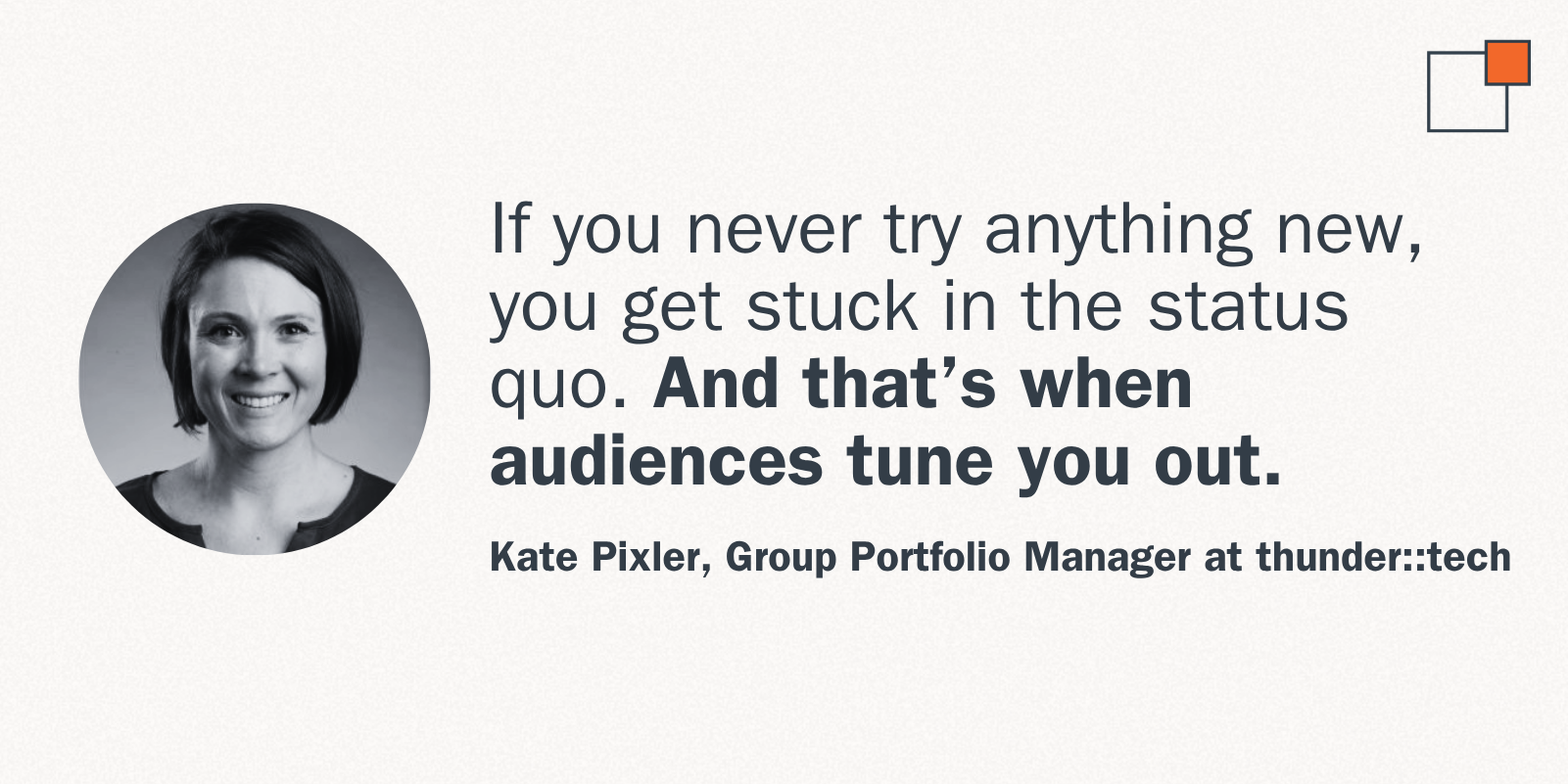
Kate: Just test it. Run a short trial—45 or 60 days. If you never try anything new, you get stuck in the status quo. And that’s when audiences tune you out.The real risk isn’t trying something new; it’s what I call the “Status Quo Tax.” When you stick only to what feels safe, your results eventually plateau while your costs go up. Testing isn’t about being flashy; it’s about finding the next lever to drive your costs down and your revenue up.
You don’t have to bet the whole farm. Carve out a small innovation budget—maybe 10%—to find what works next. It’s about doing the legwork now so that when you’re ready to scale, you’re doing it with a proven winner.
t::t: But as you start adding those innovation budgets and new experiments, how can brands stay accountable to their core marketing strategy without letting the fast pace of innovation take over?
Kate: Regular reevaluations. Our Performance Marketing team is a perfect example of what brands should be doing: they check daily to see how things are performing and make changes when needed.Because you’re paying such close attention to results, you can afford to try something bold. This approach turns what brands used to think are risks into calculated experiments. You’re doing the hard work of monitoring the pulse of your campaigns, so that when you see a spark of something new that works, you can pour gasoline on it. It’s not about slowing down; it’s about having the right dashboard so you can drive faster with confidence.
t::t: And once you’re used to monitoring and adjusting in the moment, how can brands ensure one campaign improves the next?
Kate: After you run a campaign, look at what worked and what didn’t and ideally, you’re looking while a campaign is running to see where you can optimize your efforts in the moment. If something isn’t working or not getting the results you need, you change it.Don’t be afraid to try something different, but make sure it’s grounded in your results. For example, you might find that while your paid ads are driving traffic, it’s actually your organic social content and community discussions that are providing the social proof needed to close the sale. If your audience responds better to videos and testimonials over static images, you apply those learnings to your next project to make your spend go further.
When you treat every campaign as a learning opportunity, you stop guessing. You’re building a predictable engine that gets more efficient and more profitable every time you hit launch.
t::t: Finally, what advice would you give marketing leaders who are under pressure to prove value right now?
Kate: Always have your data ready. Know your conversion rates, form fills, calls—whatever matters to your goals. But also have a roadmap. The data tells you where you are but the roadmap tells your stakeholders (and reminds you!) where you’re going. If a campaign isn’t hitting its targets, don’t just report the miss; show the pivot.Kate only spilled a tad bit of our marketing knowledge—just imagine all the good stuff we packed into the latest edition of Marketing Trends. Download Read Between the Headlines: Rethinking Your Marketing Assumptions for free and give it a read!
About the Author
Kate Pixler is the Group Portfolio Manager at thunder::tech and is based in Northwest Ohio. When she’s not making sure clients are seeing the BOOM, you can find her at the tennis courts watching her two daughters crush the competition.