What Is AEO and How Do You Write for It?
Google AI Overviews, ChatGPT and Perplexity aren't browsing your content the way a person would. Instead, they work more like an attorney building a case on a deadline; they scan for clear, trustworthy information they can quickly pull from and reference and if your content is overloaded with filler or buries the answer beneath endless paragraphs, those AI tools are far more likely to skip it and move on to a source that gets to the point faster.
This is the core premise of Answer Engine Optimization, or AEO. If you’re still unclear on what AEO is or why it matters, start here. But if you’re ready to move from understanding AEO to actually applying it, this piece is for you.
The real question isn’t just what AEO is anymore, but how to write content AI tools actually pull from, reference and use in their answers.
You can be an expert and still lose the “case" because the most knowledgeable witness does not automatically win; the most communicative one does.
Now, you're thinking: "but our brand has genuine expertise. We publish more and go deeper. We know our industry better than our competitors do." But if your content makes it hard to extract a clear answer, AI systems will surface those competitors if they explained it more simply.
Put yourself in the courtoom and imagine a witness who gives the jury a usable answer versus one who buries it under qualifications, niche jargon or a long-winded answer. Yawn. Moving on.
The jury, (in this case, the answer engine), doesn't have time or the attention span to get through that. It has milliseconds. For marketing teams used to measuring success through traffic and clicks, this reality creates a hurdle because these AI platforms synthesize your expertise and deliver it directly to the user. That's not a reason to panic, but rather a reason to write like a better expert witness.
SEO is how you get called to testify. It establishes relevance, builds authority and gets you in the room. AEO determines what happens next. It decides whether your input is used.
You can have strong SEO credentials such as domain authority, keyword coverage and sound technical structure and still fail the AEO test if your content is difficult to extract from.
The practical difference:
Most marketing teams have focused heavily on the first and overlooked the second, but the strongest strategies now address both stages.
Many pages do the opposite; they open with long introductions and brand framing before delivering the answer. AI systems look for direct responses near the top of a section. If the answer is buried, it may not be picked up.
Example:
Answer first. Add context after.
FAQ sections are especially effective because they mirror how people search. If your content answers a specific question, format it that way.
A simple test: can someone land on your page and find the core answer in five seconds? If not, an AI system likely cannot either.
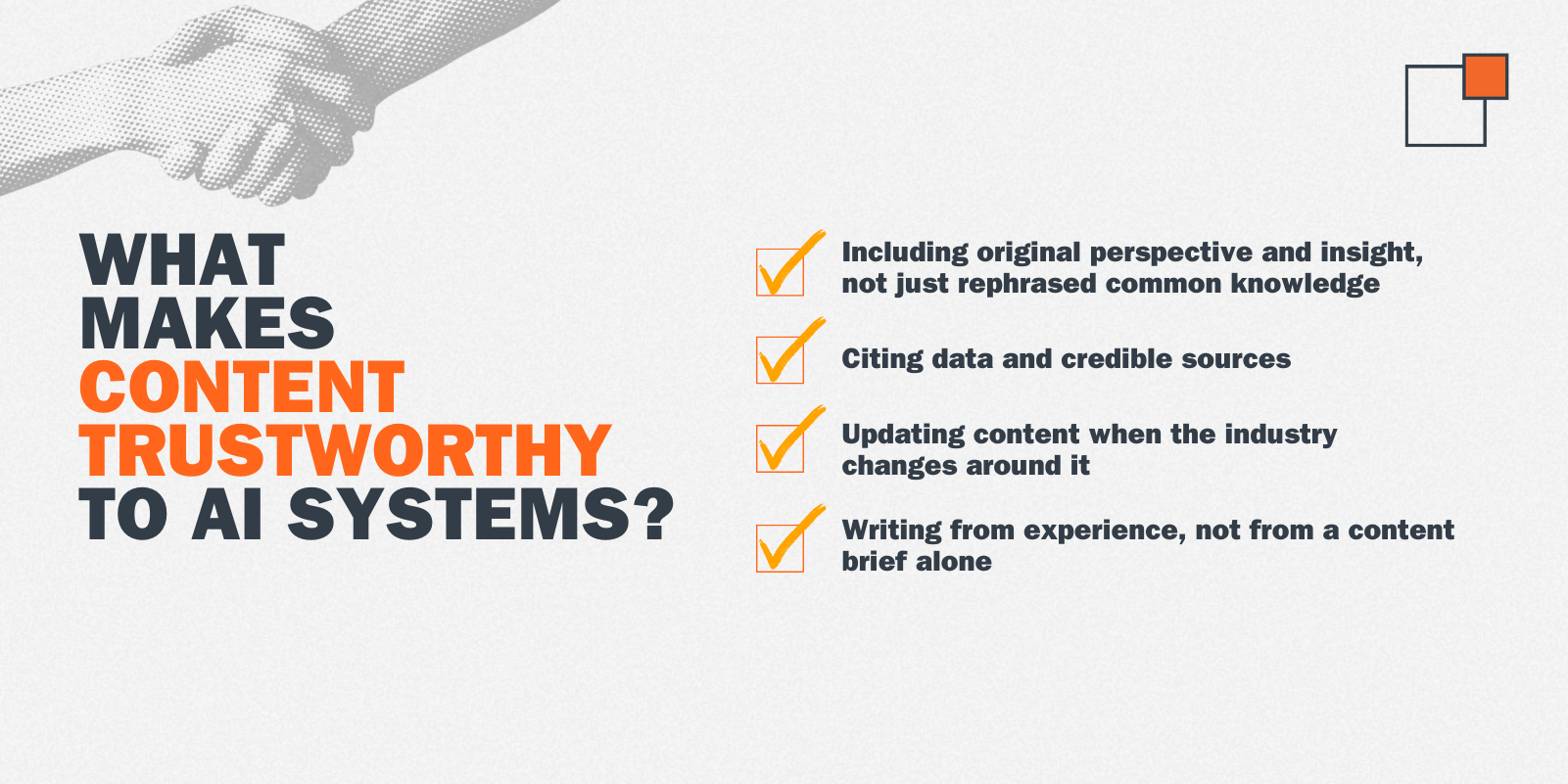 As concerns about AI-generated misinformation grow, answer engines are getting better at filtering for the same things—genuine expertise, accurate information and content that demonstrates real-world experience rather than surface-level coverage.
That means:
Voice search and conversational AI have shifted how people phrase their queries. Users aren't searching "AEO content optimization strategy." They're asking "how should I write content for AI search?"
Your content should sound like it's answering a real question from a real person—because it is. If a sentence sounds stilted read aloud, rewrite it.
These formats work well:
That is now the role of content in an AI-driven search environment.
The brands that sustain visibility will not be those that publish the most. They will be the ones whose content is easy to quote, easy to trust and easy to extract from.
Write for the jury. Build content designed to be used.
Ready to go deeper on how answer engines work and what AEO means for your marketing strategy? Talk to one of our AEO specialists today.

This is the core premise of Answer Engine Optimization, or AEO. If you’re still unclear on what AEO is or why it matters, start here. But if you’re ready to move from understanding AEO to actually applying it, this piece is for you.
The real question isn’t just what AEO is anymore, but how to write content AI tools actually pull from, reference and use in their answers.
Why isn’t your content getting used by AI tools?
You can be an expert and still lose the “case" because the most knowledgeable witness does not automatically win; the most communicative one does. Now, you're thinking: "but our brand has genuine expertise. We publish more and go deeper. We know our industry better than our competitors do." But if your content makes it hard to extract a clear answer, AI systems will surface those competitors if they explained it more simply.
Put yourself in the courtoom and imagine a witness who gives the jury a usable answer versus one who buries it under qualifications, niche jargon or a long-winded answer. Yawn. Moving on.
The jury, (in this case, the answer engine), doesn't have time or the attention span to get through that. It has milliseconds. For marketing teams used to measuring success through traffic and clicks, this reality creates a hurdle because these AI platforms synthesize your expertise and deliver it directly to the user. That's not a reason to panic, but rather a reason to write like a better expert witness.
What’s the difference between SEO and AEO?
SEO and AEO are not in competition. They operate in sequence, like stages of a case.SEO is how you get called to testify. It establishes relevance, builds authority and gets you in the room. AEO determines what happens next. It decides whether your input is used.
You can have strong SEO credentials such as domain authority, keyword coverage and sound technical structure and still fail the AEO test if your content is difficult to extract from.
The practical difference:
- SEO earns you the ranking; AEO earns you the citation
- SEO gets you discovered; AEO gets you used
Most marketing teams have focused heavily on the first and overlooked the second, but the strongest strategies now address both stages.
How should you write content for AI search?
Lead with the answer, not the biography
Strong witnesses do not spend twenty minutes outlining credentials. They establish authority quickly and move to the substance.Many pages do the opposite; they open with long introductions and brand framing before delivering the answer. AI systems look for direct responses near the top of a section. If the answer is buried, it may not be picked up.
Example:
Instead of: "As the landscape of digital marketing continues to evolve in response to shifts in search behavior and AI-driven technology..."
Write: "AEO is the practice of structuring content so AI systems can extract and surface direct answers. Here is what that means for how you write."
Write: "AEO is the practice of structuring content so AI systems can extract and surface direct answers. Here is what that means for how you write."
Answer first. Add context after.
How should I structure content for AI search?
Even a strong expert fails if the jury gets lost. Effective testimony is organized so key points are clear and easy to reference. For AI systems, structure shows up in formatting. Question-based headings, short paragraphs and lists signal what a section contains.FAQ sections are especially effective because they mirror how people search. If your content answers a specific question, format it that way.
A simple test: can someone land on your page and find the core answer in five seconds? If not, an AI system likely cannot either.
What makes content trustworthy to AI systems?
Courts don't just accept any expert witness. They vet credentials, look for conflicts of interest and assess whether the source is genuinely reliable.
That means:
- Including original perspective and insight, not just rephrased common knowledge
- Citing data and credible sources
- Updating content when the industry changes around it
- Writing from experience, not from a content brief alone
Does AI prefer simple or technical language?
The best expert witnesses are the ones who can take complex material and explain it in language a layperson can actually follow. They don't talk down to the jury. But they also don't perform expertise through jargon.Voice search and conversational AI have shifted how people phrase their queries. Users aren't searching "AEO content optimization strategy." They're asking "how should I write content for AI search?"
Your content should sound like it's answering a real question from a real person—because it is. If a sentence sounds stilted read aloud, rewrite it.
What content is easiest for AI to extract from?
Some formats are better positioned to perform as expert testimony. They are easier to extract from, organize information clearly and support citation.These formats work well:
- FAQ sections that respond directly to user questions in a recognizable structure
- Step-by-step guides that present ordered information with clear sequencing
- Comparison content that supports decision-making queries
- Definitions and plain-language explanations that clarify concepts
- Summary sections near the top that establish relevance quickly
The verdict
The role of an expert witness is not to demonstrate depth alone, but to deliver what decision-makers need in a clear and credible way.That is now the role of content in an AI-driven search environment.
The brands that sustain visibility will not be those that publish the most. They will be the ones whose content is easy to quote, easy to trust and easy to extract from.
Write for the jury. Build content designed to be used.
Ready to go deeper on how answer engines work and what AEO means for your marketing strategy? Talk to one of our AEO specialists today.
About the Author
Gabriella Caldwell is a Senior Creative Marketing Strategist at thunder::tech. Outside of the office, she can be found in a ceramics studio sculpting away or visiting local art galleries.